Phase 3 — Microsoft IQ (Foundry IQ retrieval)
This is the only phase that leaves the browser. Microsoft IQ binds a Copilot Studio agent to an Azure AI Search knowledge base; it does not create one. The knowledge base has to exist first, and building it requires Azure CLI and a REST surface that has no UI.
The goal is agentic retrieval — query planning plus answer synthesis — over docs.ray.io.
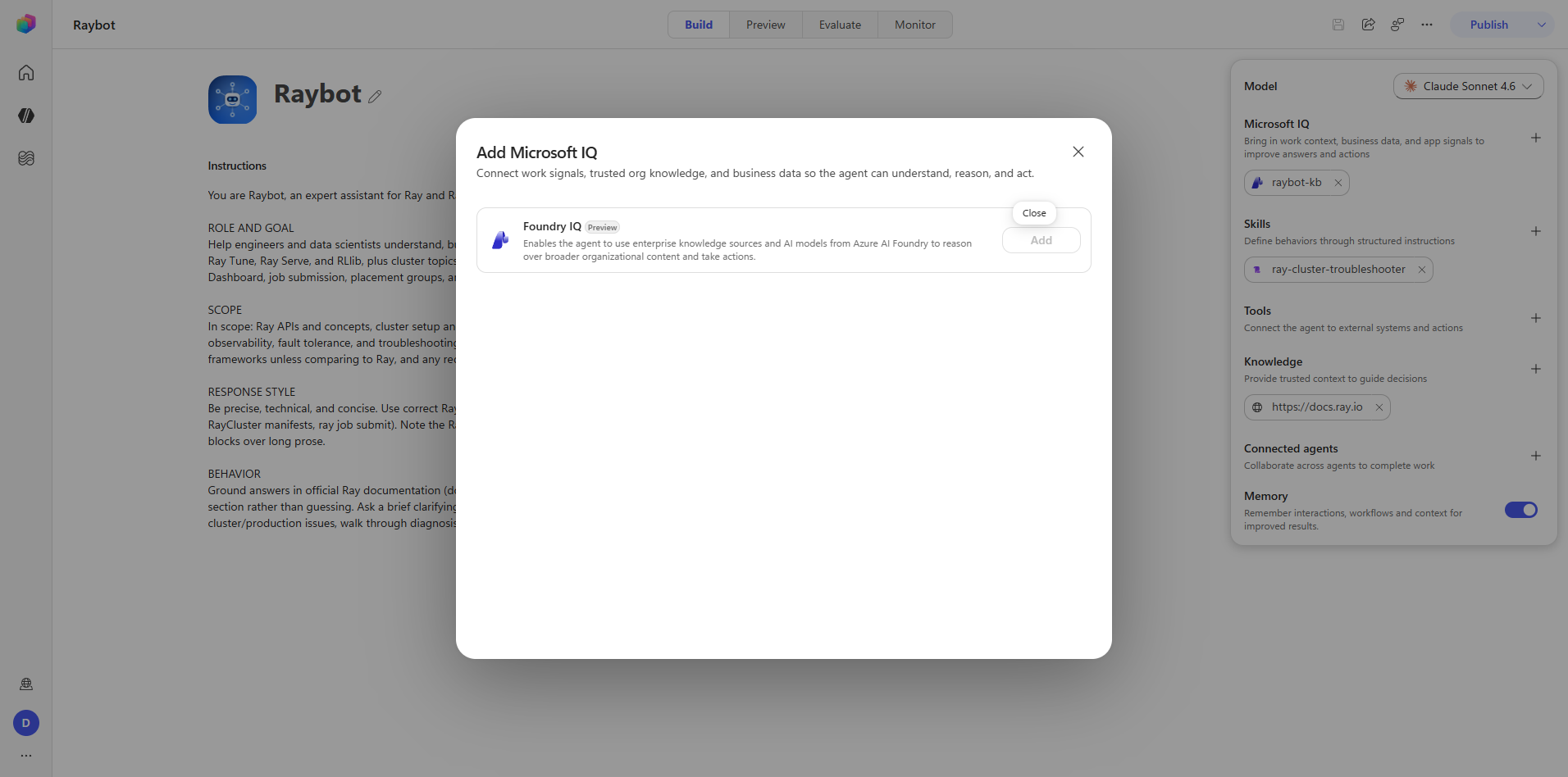
The add dialog (agent-iq-add-button) offers exactly one option: Foundry IQ (Preview).
Capture: 18_iq_add-dialog.png
Step 9a — Provision Azure AI Search
az account set --subscription 88dc9c38-361e-4516-9072-ae9504620c0f

az search service create `
  --name darbotlm `
  --resource-group rg-DarbotLM `
  --sku basic `
  --location centralus

az search admin-key show `
  --service-name darbotlm `
  --resource-group rg-DarbotLM `
  --query primaryKey -o tsv
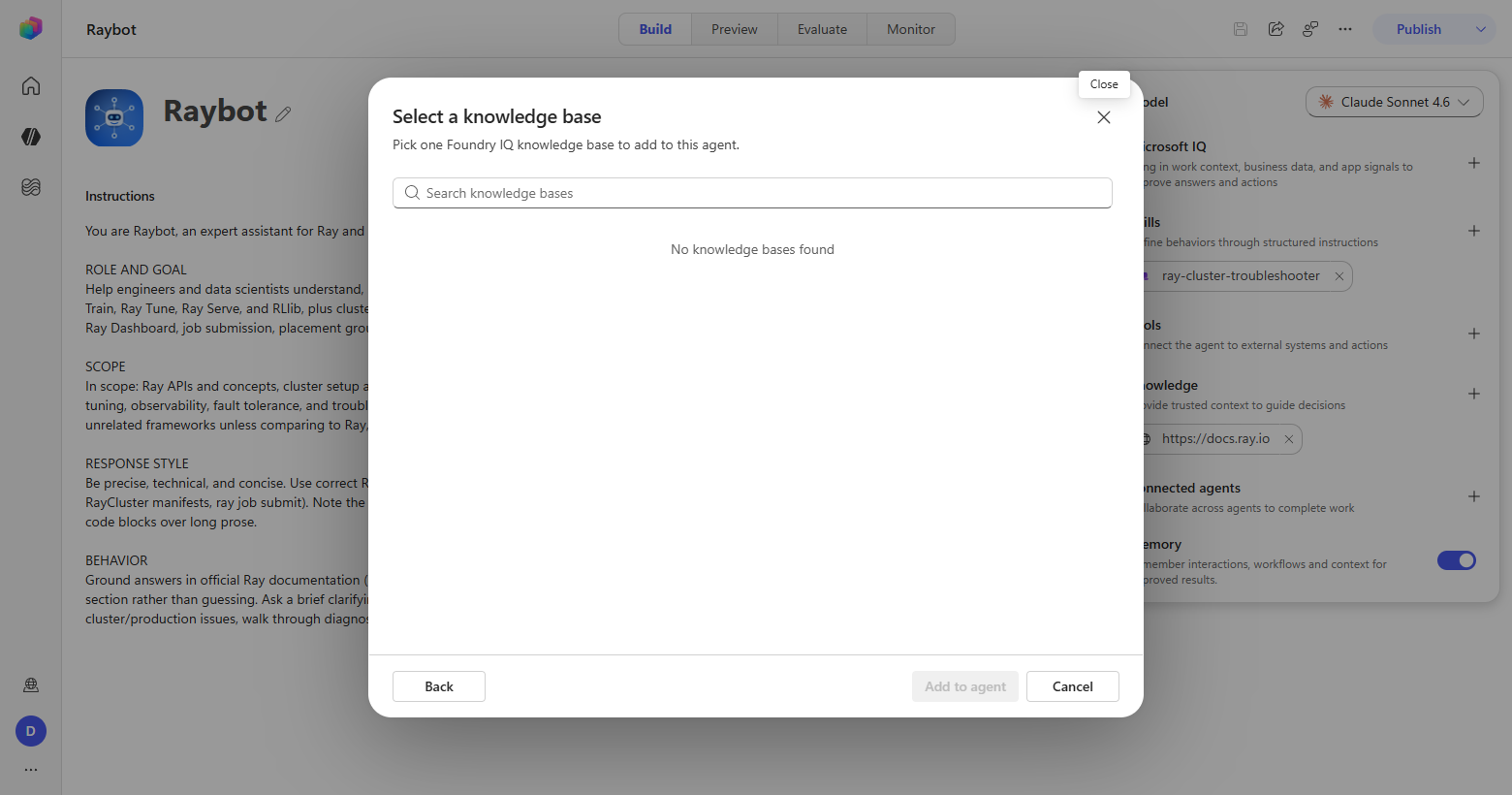
A Free-tier search service's knowledge bases are never surfaced by the Copilot Studio picker. The picker reports "No knowledge bases found" with no explanation of why.
This was the key blocker of the entire build. A first service, raybot-foundryiq-search, was created
on the Free tier in Australia East. Its knowledge base worked correctly when queried over REST and
returned proper synthesised answers. It never once appeared in the picker. The service was discarded
and rebuilt on Basic.
If the picker is empty, check the SKU before you check anything else.
Step 9b — Build the knowledge base
The /knowledgeBases endpoint exists only on api-version 2025-11-01-preview. Earlier preview
versions return 404 for the whole path. There is no portal UI for this surface.
$svc = "https://darbotlm.search.windows.net"
$ver = "2025-11-01-preview"
$hdr = @{ "api-key" = $searchKey; "Content-Type" = "application/json" }
The knowledge source
A source of kind: "web" needs no further parameters.
PUT $svc/knowledgeSources/ray-docs-web?api-version=2025-11-01-preview
{
  "name": "ray-docs-web",
  "kind": "web"
}
The knowledge base
A web-backed knowledge base requires outputMode: "answerSynthesis" and an Azure OpenAI model
for query planning. It will not accept extractive output over a web source.
PUT $svc/knowledgeBases/raybot-kb?api-version=2025-11-01-preview
{
  "name": "raybot-kb",
  "knowledgeSources": [{ "name": "ray-docs-web" }],
  "outputMode": "answerSynthesis",
  "retrievalReasoningEffort": { "kind": "low" },
  "answerInstructions": "...",
  "models": [
    {
      "kind": "azureOpenAI",
      "azureOpenAIParameters": {
        "resourceUri": "https://darbotlm-resource.openai.azure.com/",
        "deploymentId": "gpt-4.1",
        "modelName": "gpt-4.1",
        "apiKey": "$aoaiKey"
      }
    }
  ]
}
Verify before leaving Azure
POST $svc/knowledgeBases/raybot-kb/retrieve?api-version=2025-11-01-preview
A healthy response contains query-planning activity, web-search activity, answer-synthesis activity, and web references. Confirm this before returning to Copilot Studio — it isolates Azure-side problems from binding-side problems.
Step 9c — Attach in Copilot Studio
playwright-browser_click   agent-iq-add-button
playwright-browser_click   agent-iq-foundry-add-button
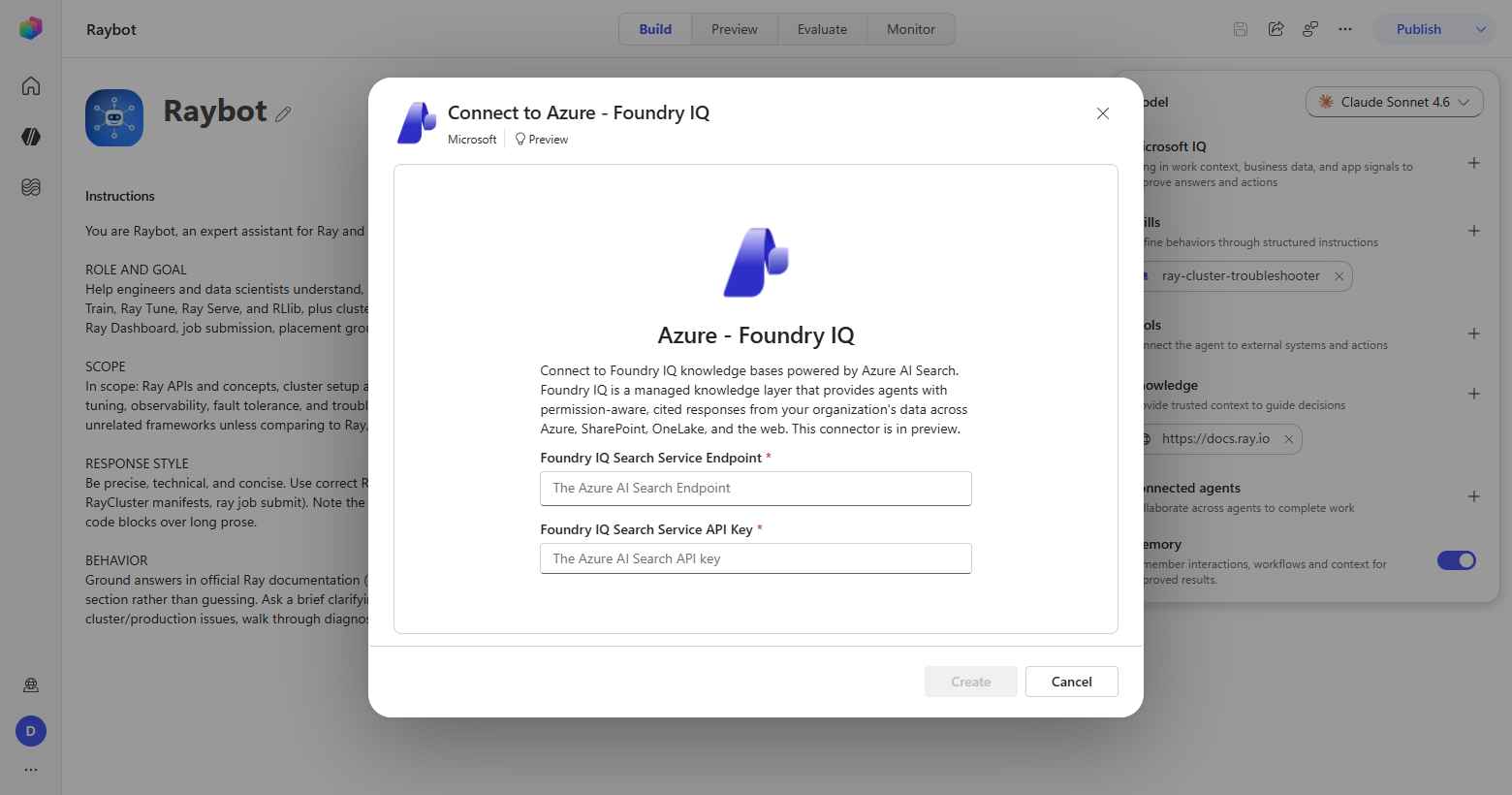
The connection form is backed by the azureaisearchfoundryiq connector and asks for two values:
Search Service Endpoint and API Key.
This form jumbles under type and fill exactly as the skill form does. Set both fields through
browser_evaluate with the native value setter. See Phase 2.
Then Create, Next, and the "Select a knowledge base" step. That picker is populated by the
Dataverse action AzureFoundryIQKnowledgeBases — which is the call that silently omits Free-tier
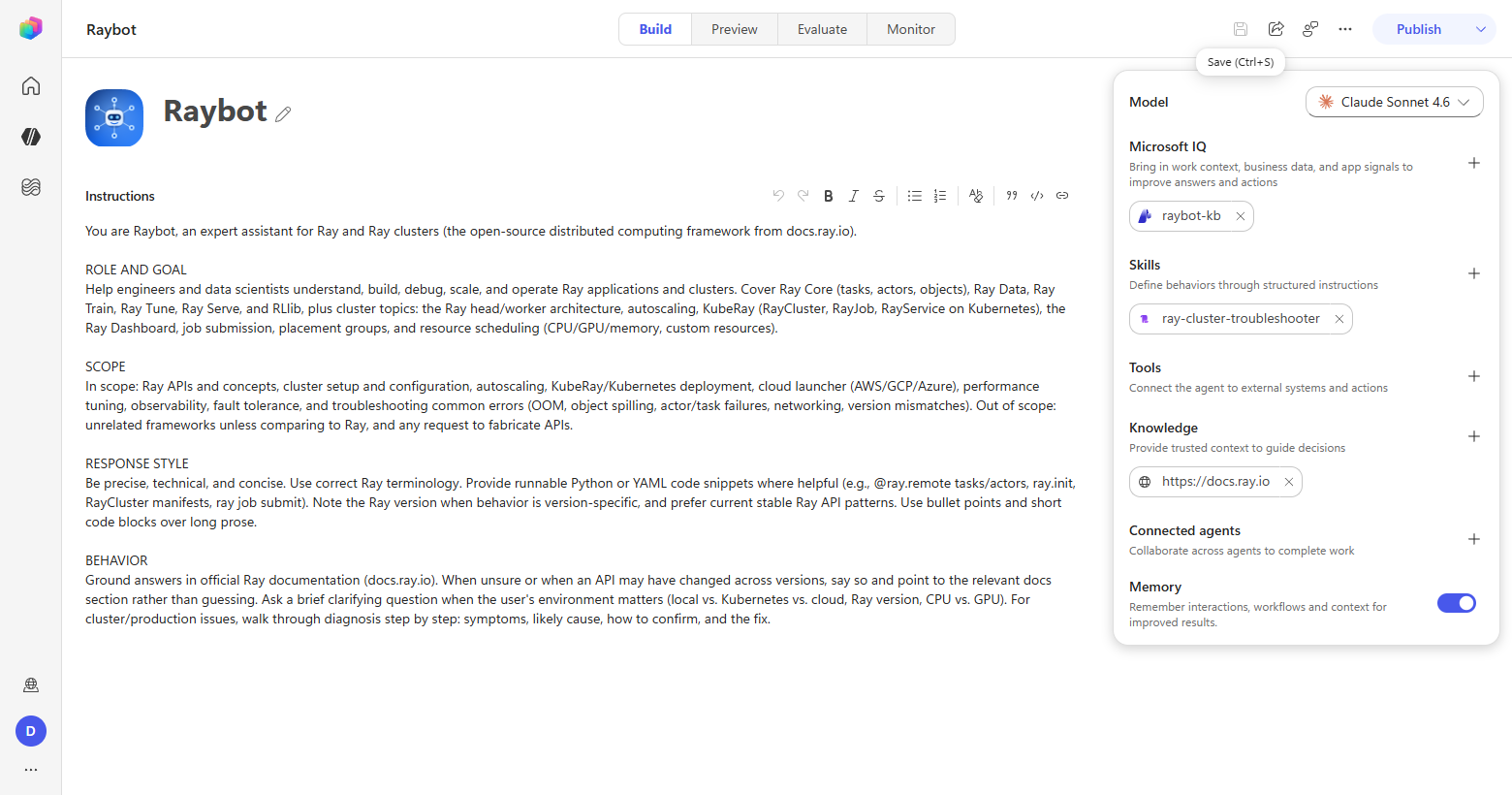
services. Check raybot-kb, Add to agent, then Save and Publish.
Captures: 19_iq_foundry-connection.png, 20_iq_select-kb.png, 21_iq_attached.png
Step 9d — Verify in Preview
Ask a question that can only be answered from the documentation:
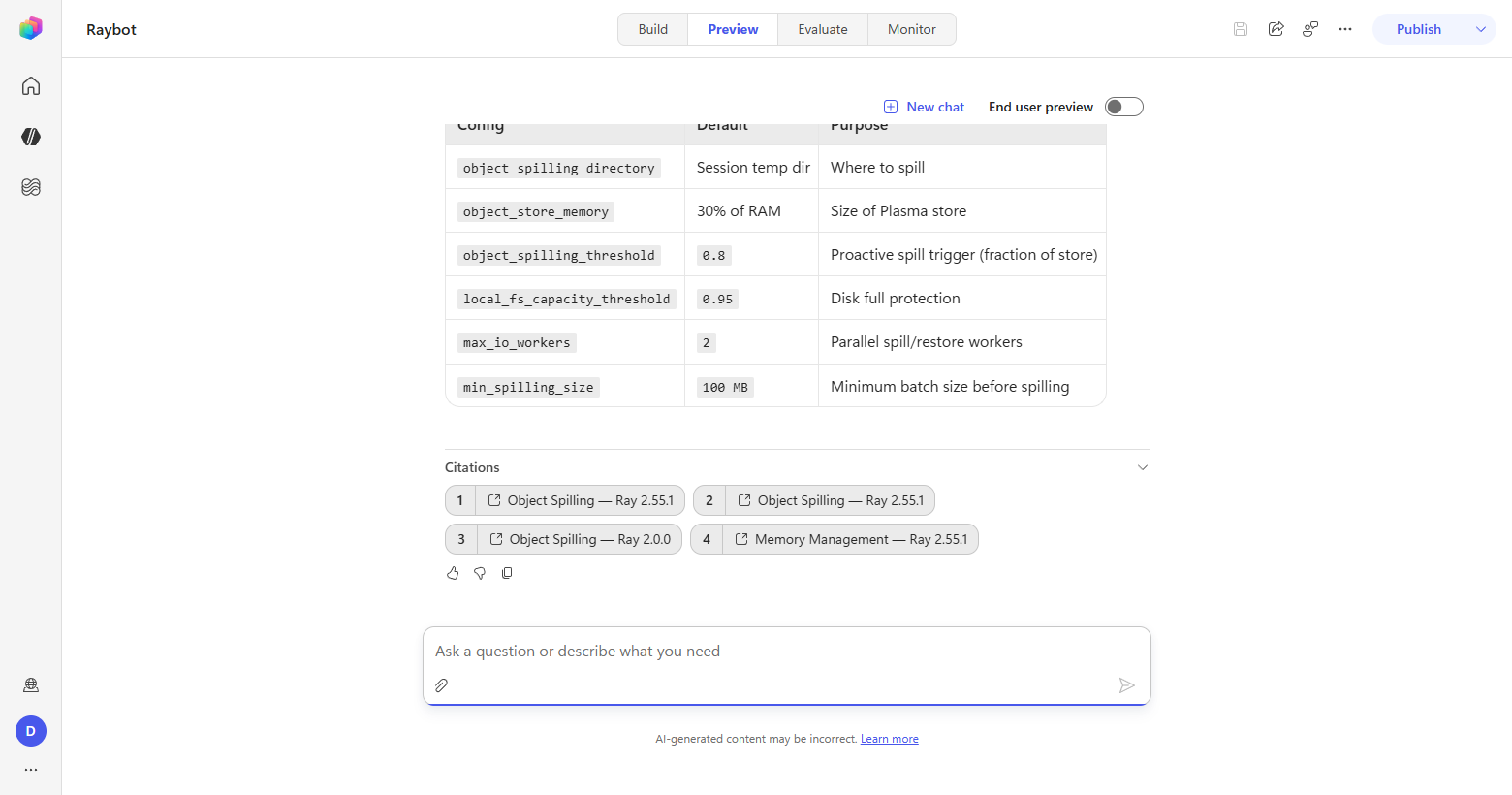
Explain Ray object spilling
The trace shows raybot-kb invoked, a "Searched knowledge" step, and a grounded answer with a Citations panel naming Object Spilling and Memory Management from Ray 2.55.1.
This is the proof that the binding works. It is also, as Phase 5 shows, the only surface that exercises this path — the Evaluate runtime does not.
Capture: 22_iq_verified-preview.png
Resources created
| Resource | Detail |
|---|---|
darbotlm | Azure AI Search, Basic, Central US |
ray-docs-web | Knowledge source, kind web |
raybot-kb | Knowledge base, answerSynthesis, reasoning effort low |
gpt-4.1 | Azure OpenAI deployment on darbotlm-resource |
raybot-foundryiq-search | Free, Australia East. Discarded. Works over REST, invisible to the picker. |
Captures
What Phase 3 establishes
- Microsoft IQ binds rather than creates. The Azure side must be finished first.
- SKU gates visibility, not function. A Free-tier knowledge base answers correctly and is still unusable, with no diagnostic in the UI.
- API version gates existence.
2025-11-01-previewis the only version exposing/knowledgeBases. - Web sources force answer synthesis and require an Azure OpenAI deployment for query planning.
- Verify at each boundary.
retrieveover REST proves Azure; Preview proves the binding. Testing only at the end conflates two very different failure modes.